
Polymer producers invest heavily in clean rooms, dedicated lines, raw-material qualification and operator training, yet black specks and off-colour pellets still reach the bag. A single contaminant in a translucent moulding can trigger a customer complaint, a re-sorting campaign or a rejected lot. Because pellet cleanliness is specified in parts per million rather than in tonnes, the last fraction of a percent is also the most expensive one to defend by hand.
Visual inspection is where that cost concentrates. Manual picking is slow, inconsistent between shifts and impossible to audit. At production throughput it is, by definition, a sampling exercise: the material that is checked is clean, and the material that is shipped is not necessarily the material that was checked.
What the GS-1000 Pro does
The GS-1000 Pro is an optical sorting machine purpose-built for the cleanliness of natural-colour resin pellets — transparent, translucent and opaque. Three high-resolution CMOS line-scan cameras photograph the pellets in free fall; defect-recognition software classifies what it sees — black specks, black spots, black granules, off-colour pellets — and an air-jet array removes the offending granule in real time. The unit runs unattended, batch after batch, at a standard throughput of approximately 1,000 kg/h on PE and PP, with capacity and resolution configurable to the line.
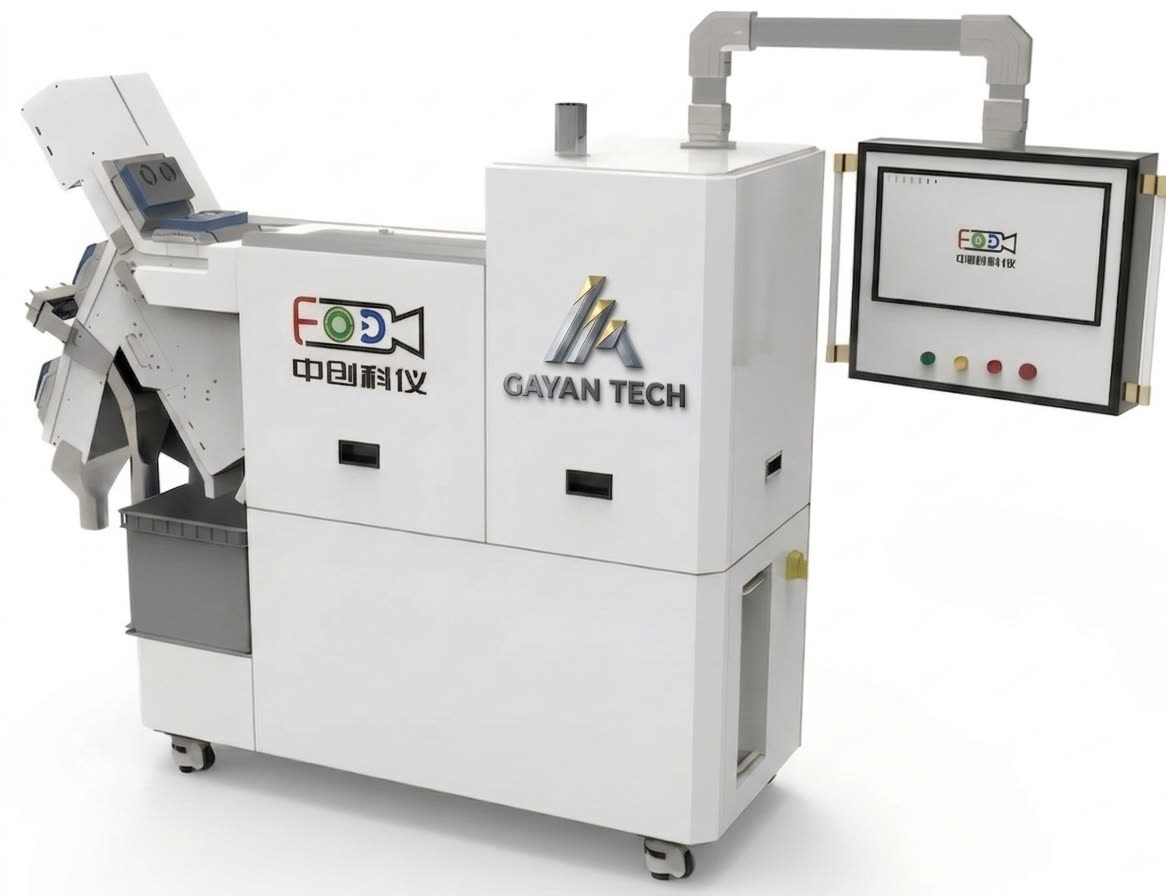
What the camera has to find
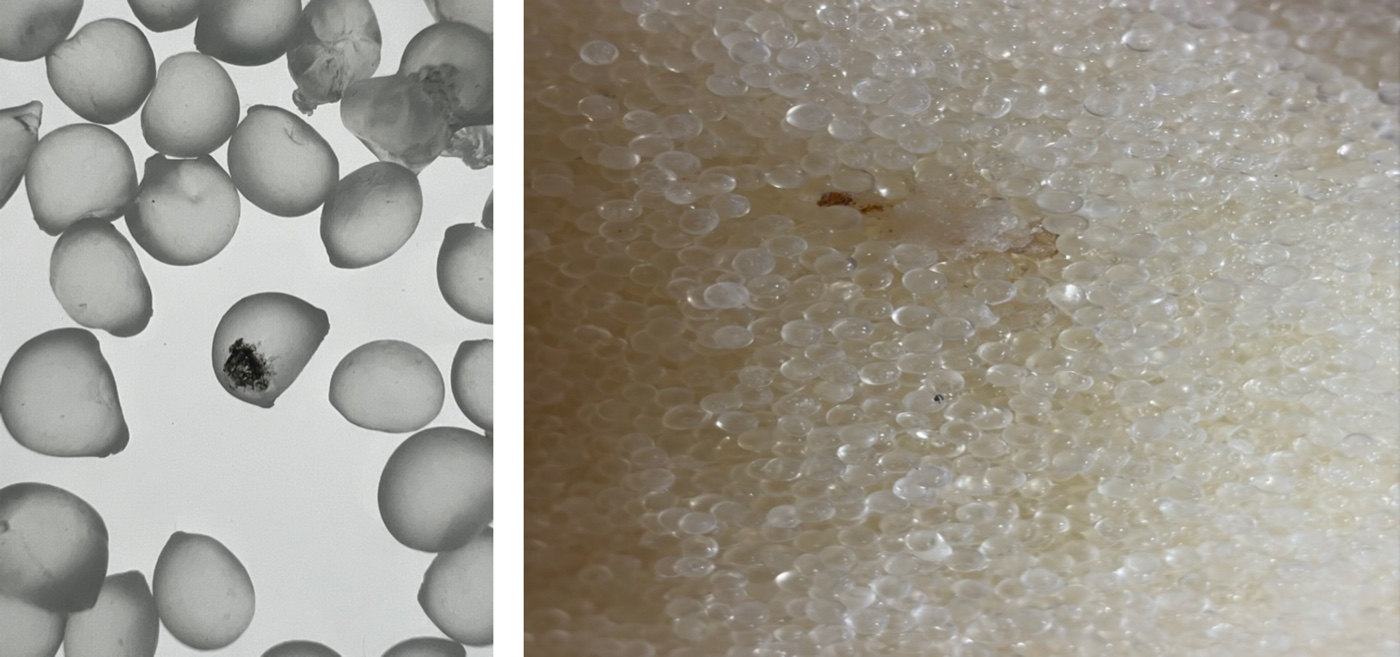
Cleanliness specifications are written in micrometres, but the argument is usually made in pictures. The two views below are typical of what the machine is asked to separate: a single black speck embedded in an otherwise acceptable pellet, and the same class of contamination sitting in a bag of production material thin enough to pass a casual visual check.
This is exactly the regime in which human inspection degrades. The defect is small, the contrast is low, and the same judgement has to be repeated tens of thousands of times an hour. It is also the regime in which a camera with stabilised illumination and a calibrated threshold holds a structural advantage over an operator with a sample tray.
Three details that decide accuracy
Single-layer presentation. Pellets enter through piping onto a vibrating platform and leave it in free fall, so no granule hides behind another. Separation upstream is what makes sub-25 µm discrimination downstream physically possible.
Three cameras, not one. The cameras are mounted face to face, capturing the front, back and side of every pellet in a single pass — 8,192 pixels per line, up to 40,000 lines per second — and closing the blind spots that a one-lens arrangement leaves open.
Illumination held constant. LED white light with automatic brightness control keeps the imaging environment uniform, so the same defect is judged the same way at 06:00 and at 22:00. A self-learning defect library then tightens the thresholds as production data accumulates.
The loop, end to end
Feed, image, classify, eject — four stages in continuous motion, with a response time measured in milliseconds and no operator in the chain:
- Feed and monolayer separation — pellets are released into free fall so every granule travels alone
- Three-camera line-scan imaging — front, back and side of each pellet under stabilised LED light
- Self-learning classification — black specks, black spots, black granules and off-colour pellets tagged by size, area and shape
- Air-jet ejection — a high-speed valve diverts the single defective granule milliseconds after the call
Accepted pellets continue to the product silo; rejected pellets are diverted into a defect bin, and the reason for every diversion is written to the database.
Performance at a glance
| Parameter | Specification |
|---|---|
| Detection resolution | ≤ 25 µm (line-scan) |
| Camera system | 3 × CMOS line-scan cameras (B/W), 8,192 px each; ≥ 40,000 lines/s (pixel frequency ≥ 160 MHz) |
| Signal quality | SNR better than 62 dB; 2 × Teledyne Dalsa frame grabbers |
| Throughput | ≈ 1,000 kg/h (PE, PP; depends on bulk density — customisable) |
| Sorting accuracy | ≥ 95 % |
| Good-pellet carry-over | Better than 1 : 20 |
| Light source | White LED, IP54, service life ≥ 50,000 h |
| Operating environment | 10–45 °C, 35–75 % RH, non-condensing |
| Control platform | Industrial PC (i7 / 16 GB / 2 TB SSD), 21.5″ display, Windows 10 or later |
| Power and utilities | 220 V / 16 A / 50–60 Hz; clean dry compressed air 5–6 bar, ≥ 200 L/min |
| Footprint and connections | 3,000 × 1,500 mm; min. 2,000 mm headroom; inlet/outlets Ø 76 mm |
| Reference standards | GB/T 37197, GB/T 11115, SH/T 1541 |
Specifications reflect the standard configuration; capacity, resolution and reporting are configurable to the line.
What changes on the line
Inspection stops being a sample. Every pellet passes the camera; every bag that ships has been sorted, not spot-checked.
Quality becomes data. Each rejection is logged with defect type, size, area, shape and timestamp. Trend, histogram and size-distribution views show whether a problem originates in the reactor, the pelletiser or the conveying system — the difference between fixing a symptom and fixing a cause. In the inspection software, every archived rejection carries an ID, a defect class and its measured size in micrometres, filterable by type, size band or time window; software screenshots are available on request.
Yield loss stays bounded. A carry-over ratio better than 1 : 20 caps the clean material removed with each defect. That number — not accuracy alone — is what determines whether automatic sorting pays for itself.
People move up the value chain. Operators leave the picking bench and move to data review and process correction; customisable reports, multi-level permissions and a queryable database turn a customer claim into a traceable record.
Where it fits
Compounding and modification lines, petrochemical pellet finishing, injection moulding, packaging film, cable compounds, battery materials and medical-grade resins. The case is strongest in mechanical recycling, where the contaminant load makes manual sorting uneconomic and the value of a clean stream is highest.
If any of this describes your line, the fastest next step is a trial on your own material: send a 25 kg sample and the first sorting test is free — it tells you in days what a manual campaign would take months to approximate.