
Standard — Monochrome (B/W) line-scan
3 × 8,192 px cameras, detection down to 25 μm. Recommended for maximum detection sensitivity on natural pellets.
Machines · GS-Series Sorter
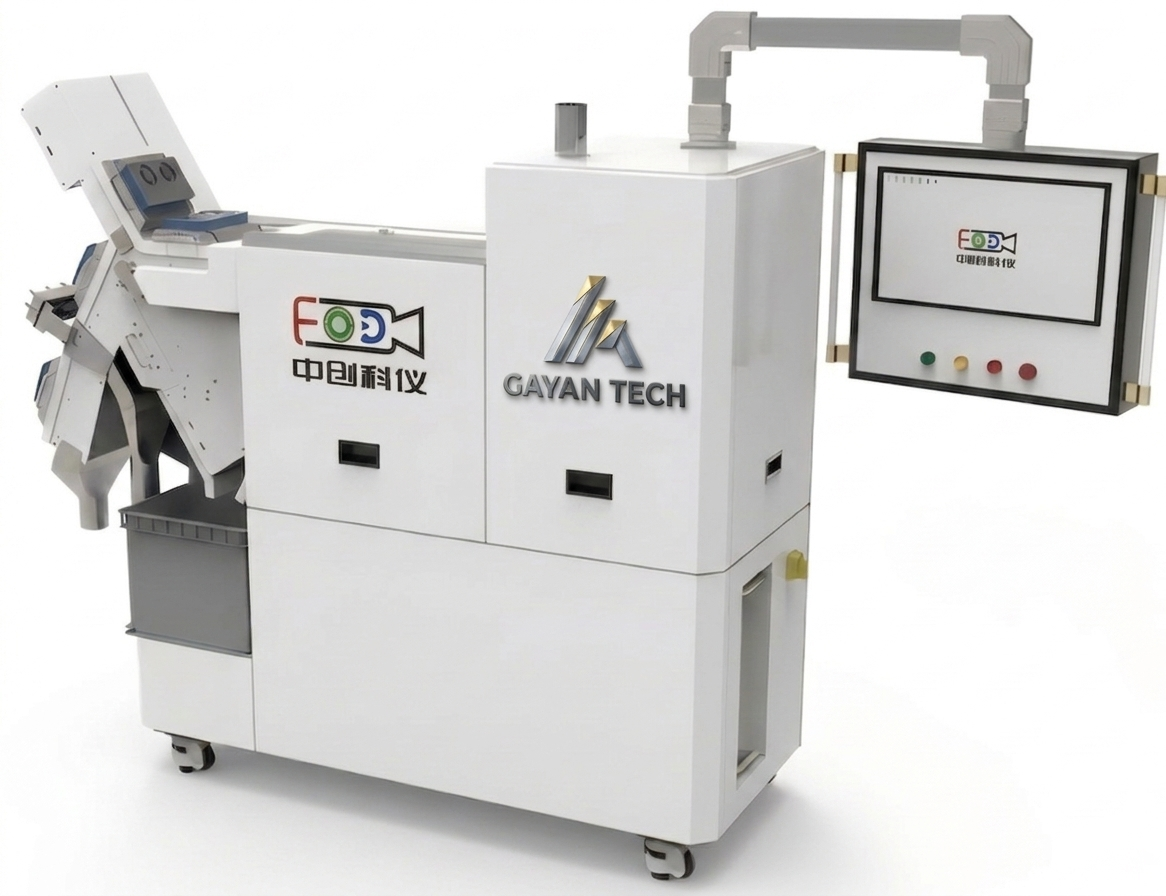
Inline optical sorting for transparent, translucent, and opaque natural polymer pellets — black specks, contamination, and color defects detected at 25 μm and rejected automatically. Up to 1,000 kg/h.
| Reference standards | GB/T 37197, GB/T 11115, SH/T 1541 |
|---|---|
| Detection resolution | ≤ 25 μm (line-scan) |
| Cameras | 3 × CMOS line-scan cameras (B/W), 8,192 px each |
| Line rate | ≥ 40,000 lines/s (pixel frequency ≥ 160 MHz) |
| SNR | Better than 62 dB |
| Image processing | 2 × Teledyne Dalsa frame grabbers |
| Throughput | ≈ 1,000 kg/h (PE, PP; depends on bulk density — customizable) |
| Sorting accuracy | ≥ 95 % |
| Defect carryover ratio | Better than 1:20 |
| Light source | White LED, IP54, ≥ 50,000 h life |
| Operating environment | 10–45 °C, 35–75 % RH (non-condensing) |
| Workstation | 21.5″ display, Intel Core i7, 16 GB RAM, 2 TB SSD |
| Utilities required | 220 V / 16 A / 50–60 Hz; clean dry compressed air 5–6 bar, ≥ 200 L/min |
| Footprint | 3,000 × 1,500 mm; min. 2,000 mm headroom; inlet/outlets Ø 76 mm |
| Manufacturer's reference model | PS50-Advance — engineered and built by ZhongChuang (FOD Instruments), Beijing |
3 × 8,192 px cameras, detection down to 25 μm. Recommended for maximum detection sensitivity on natural pellets.
3 × 4,096 px color cameras, detection down to 50 μm. Choose when color discrimination between defect types matters more than absolute resolution. All other specifications are identical.
Not sure which fits your application? Send us a sample — we'll run both configurations and recommend based on your actual defect spectrum.
Pellets are fed from your pipeline (DN90) onto a vibration platform, then free-fall through the inspection zone where three opposed line-scan cameras capture every pellet. The software flags black specks, contaminated, and color-deviant pellets in real time — and the rejection unit ejects them instantly into a segregated defect stream. Clean pellets continue to your good-material silo. The whole line runs unattended, with live video, defect annotation, and statistics throughout.
Send us a 25 kg sample. We'll run it on the GS-1000 Pro, and send back the video, the reject statistics, and the cleaned-pellet result. The first sample test is free.